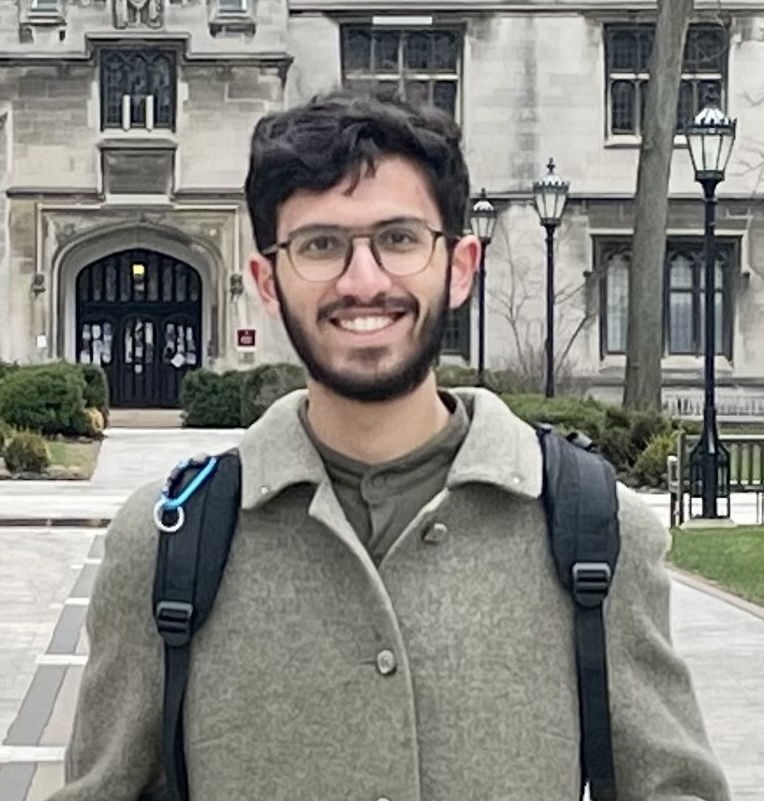
Bio
I am a Research Fellow (predoc) at Harvard University, working with Prof. Asim Khwaja. Prior to joining Harvard, I was a research assistant at National University of Singapore with Profs. Martin Mattsson and Yogita Shamdasani, and at Yale RISE with Prof. Mushfiq Mobarak. I hold a Bachelor of Arts (Honors, Magna Cum Laude) from Yale-NUS College, with a major in Economics and a minor in Mathematical, Computational, and Statistical Sciences.
Curriculum Vitae (Updated Dec 2025)
Email: mbinkhalid@hks.harvard.edu
Phone: +1-857-829-0530
Research Completed
(with Martin Mattsson)
Based on Senior Honors Thesis. Won Outstanding Capstone Project at Yale-NUS College
Journal of Development Economics (Conditionally accepted)
Abstract (click to expand): Extreme weather events are expected to increase with climate change. Government relief programs are designed to ameliorate the negative consequences, but moral hazard models suggest they also reduce adaptation, such as migrating from disaster-prone areas. Using difference-in-differences, we study the long-term effects of cash relief on migration after the 2010 Pakistan floods. Combining survey and population data, we show that cash transfers have two countervailing effects. As expected, they reduce migration through a moral hazard effect and by facilitating in-situ adaptation. However, they also increase migration by providing liquidity. In practice, these effects cancel each other out in flooded areas.
Dataset
(with Steve Monroe)
Won Outstanding Undergratuate Researcher Award at National University of Singapore
Perspectives on Politics, March 2025.
Abstract (click to expand): Is smaller better for economic development? We argue that states’ past population size can be a powerful determinant of current development. Among states that gained independence shortly after World War II, states with smaller populations in their early years of independence had stronger incentives to adopt more open trade policies and employ larger public sectors. These policies “embedded” smaller newly independent states into the global economy during the Cold War, building the foundations for more inclusive economic institutions and greater political stability. When the Cold War ended, smaller newly independent states were more likely to have developed the institutional infrastructure to prosper in the globalizing yet politically volatile early twenty-first century. We test this argument by examining the developmental trajectories of 83 states that became independent between 1946 and 1975. Newly independent states with smaller populations during this period have had on average higher levels and rates of post-Cold War development. They also had more open trade policies and larger public sectors during the Cold War. These policies correlate with more inclusive economic institutions and greater political stability in the post-Cold War era. A comparative case study of Oman and the People’s Democratic Republic of Yemen illustrates the mechanisms linking the size of newly independent states at independence and their post-Cold War development.
Replication Package
Work in Progress
Household Shocks and Children’s Time Allocation: Evidence from Pakistan
(with Asim Khwaja and Jishnu Das)
Abstract (click to expand): We study how households adjust children's time allocation in response to negative income and birth shocks. Using LEAPS panel data, we document that these shocks increase housework and reduce study time especially for girls aged above 11/12. We are currently exploring the long term welfare implications of these changes.
Others
Pakistan Census Panel:
I digitized ~6,000 village maps and ~4,500 pages of historical censuses to produce a village level geo-spatial, administrative dataset for Sindh, Pakistan, covering population and infrastructure variables over the past 7 decades (1961-2023). An interactive dashboard displaying the data is available here.